Forensic Analysis of Catalyst Pharmaceuticals (CPRX) – Q2 2025 Outlook
Catalyst Pharmaceuticals (CPRX) is a profitable rare-disease pharma with strong earnings quality and a robust balance sheet ($580.7M cash, zero debt). However, risks include looming exclusivity expirations and reliance on Firdapse. Insiders have been net sellers. CPRX stands out for high margins and moderate valuation compared to peers. Options market positioning reveals bullish speculation tempered by new hedging. A selectively bullish stance is favored, with risk-managed positioning.
Earnings Quality and Financial Resilience:
2024 revenue: $491.7M (+23.5% YoY)
2024 GAAP net income: $163.9M (depressed by one-off R&D)
2024 non-GAAP net income: $276.3M (+95% YoY)
Acquisitions introduce noise in reported earnings.
Operating costs are well-controlled.
Insiders have sold ~$3.8M in stock; no insider buys.
Balance Sheet Strength and Risk Factors:
$580.7M in cash; no debt.
Moderate dilution due to equity issuance.
Intangible assets form a significant portion of the balance sheet.
Firdapse accounts for 62% of 2024 revenues.
Patent Cliff: Firdapse's exclusivity extended to 2032+ via settlements and patents. Teva cannot market a generic Firdapse before Feb 2035. Fycompa patents expire by May 2025.
Agamree sales ramp is strong.
Competitive Positioning vs. Peers: CPRX offers an attractive mix of growth and profitability.
Compared to Sarepta (SRPT), CPRX has a more favorable margin profile and less development risk.
Compared to Supernus (SUPN), Catalyst has superior growth and margins.
Compared to Biohaven (BHVN), CPRX has current earnings vs. BHVN's R&D spending and no revenue. Long CPRX vs. short BHVN is a classic value vs. hype pair trade.
Options Market & Positioning Asymmetries:
Call option open interest has historically dominated but put open interest has surged recently.
Implied volatility has risen on the put side.
Sentiment divergence: Analysts are bullish, while some smart money is hedging.
Opaque News Flow & Sentiment Analysis:
Patent litigation and IP wins have secured Firdapse's longevity.
Agamree's launch trajectory is exceeding expectations.
Catalyst plans to continue deal-making.
Analyst and investor communications are positive.
Trade Recommendations and Scenarios:
Long CPRX – Core Long with Downside Hedge: Buy July $20 put options as protection.
Bull Call Spread: Buy August $25 calls and sell the $30 calls.
Cash-Secured Put Sale: Sell out-of-the-money puts to generate income.
Covered Call / Yield Enhancement: Sell June or September $25 call.
Long CPRX vs. Short SRPT: Hedge growth at a reasonable price.
Maintain a long bias on CPRX into the next quarter due to its strong earnings quality and multiple support, while actively hedging idiosyncratic risks.
Executive Summary
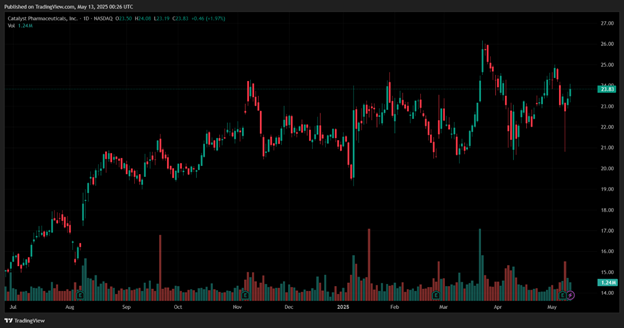
Catalyst Pharmaceuticals (NASDAQ: CPRX) has transformed into a cash-rich, profitable rare-disease pharma, but its rapid growth and rosy outlook conceal key risks. Earnings quality is strong on an adjusted basis (2024 non-GAAP net income nearly doubled YoY), yet GAAP results were distorted by one-off acquisition costs. Balance sheet stress is minimal – Catalyst ended Q1 2025 with $580.7M cash and zero debt – but looming exclusivity expirations and heavy reliance on one product pose longer-term threats. Insiders have been net sellers, unloading ~$3.8M in stock over the last year with no insider buys, signaling caution even as management issues upbeat guidance. Meanwhile, patent cliff risks for its flagship drug Firdapse (LEMS therapy) and acquired epilepsy drug Fycompa are material, though Catalyst has aggressively extended IP protection via patent litigation settlements and new patents.
Within the rare disease and neurology peer group, CPRX stands out for its high margins and moderate valuation. Unlike peers Sarepta, Supernus, and Biohaven, Catalyst already generates substantial profits and free cash flow. Options market positioning reveals bullish speculation tempered by new hedging: open interest in calls far exceeds puts (put/call OI ~0.2 recently), yet a surge in put buying has pushed the put/call ratio up to ~0.7 as some players hedge downside into the next quarter. This divergence – alongside analyst price targets ~$32-34 ( >30% above current ~$23) – suggests sentiment asymmetry: optimism in forecasts vs. cautious positioning by those mindful of risks.
High-Conviction Trade Implications: The forensic evidence favors a selectively bullish stance on CPRX, with risk-managed positioning. Catalyst’s robust earnings and fortress balance sheet support a long bias, especially relative to riskier peers. However, to guard against potential setbacks (generic entries or an expensive acquisition), investors should consider hedged strategies. For example, long CPRX paired with a short position in a cash-burning peer (e.g. Biohaven) or covered calls on CPRX to harvest elevated call premiums can provide upside exposure with protection. Likewise, bull call spreads or collars (long stock + protective puts funded by call sales) are prudent ways to participate in further upside while insulating against unforeseen downside. Below we detail our findings across fundamentals, comparables, and market positioning, then outline specific trade ideas.
Earnings Quality and Financial Resilience
Revenue and Profitability: Catalyst’s core financial performance is robust. Full-year 2024 revenue reached $491.7M (+23.5% YoY), with 2025 guidance at $545–565M (another ~12–15% growth). This growth has been both organic (Firdapse expansion, new launch of Agamree for DMD) and acquisition-driven (Fycompa). GAAP net income was $163.9M in 2024 (33% net margin), but notably this was depressed by a one-time R&D license expense. Excluding non-cash and one-off items, 2024 non-GAAP net income was $276.3M, up 95% YoY – highlighting high underlying earnings quality. Cash generation is strong as well; cash and equivalents jumped to $580.7M by Q1 2025 after a Q1 GAAP profit of $56.7M and a $150M equity raise (Jan 2024).
One-Off Charges and Accounting: The company’s acquisitive growth strategy has introduced some noise in reported earnings. In Q3 2023, Catalyst expensed $81.5M of acquired in-process R&D for licensing Agamree (vamorolone) ahead of FDA approval. This conservative accounting (treating the DMD drug license as an asset acquisition under GAAP) temporarily slashed GAAP profits – 2023 GAAP net fell 14% YoY – even as underlying operating earnings grew. Similarly, the Fycompa rights acquisition in Jan 2023 added a finite-lived intangible asset being amortized over ~5 years. Amortization of acquired intangibles was $37.4M in 2024, a substantial non-cash expense (over 7.6% of revenue). Adjusting for these, Catalyst’s cash earnings are higher than GAAP suggests, indicating quality of earnings is high – revenue is 100% derived from product sales (only $2.4M of 2024 revenue came from one-time license milestones) and margins are strong.
Expense Management: Excluding acquisitions, operating costs are well-controlled. R&D spend (apart from licensed R&D) is extremely low for a biotech – only $12.6M in 2024, ~2.5% of sales, reflecting Catalyst’s strategy to in-license or acquire late-stage products rather than fund large internal pipelines. SG&A has grown with new product launches but remains reasonable given revenue scale. The result is exceptional operating leverage: Q1 2025 saw 43.6% revenue growth translate to 143.8% GAAP net income growth. Going forward, management guides to a slight uptick in R&D to $15–20M in 2025 (supporting new trials like the AGAMREE “SUMMIT” study) – still modest. In sum, earnings appear high quality and sustainable, provided revenue holds up. Investors should monitor adjustments between GAAP and non-GAAP results, but these largely consist of amortization and stock comp rather than any aggressive revenue recognition or dubious items.
Insider Activity and Signals: Despite stellar financial performance, insiders have shown reluctance to increase their stakes. Over the last 12 months, multiple executives sold shares amounting to ~$3.8M, with no insider purchases in the period. The largest sale was by an EVP (Steven Miller) who sold $3.1M at ~$20.59. While insiders still retain significant holdings (Miller’s sale was only 18% of his stake), the lack of buying and disposition of shares at prices below current levels could indicate management views the stock as fairly valued or is simply diversifying. This insider caution contrasts with the company’s bullish public statements and may be a subtle red flag. It’s not uncommon for growth-company insiders to take profits, but the fact that insiders collectively reduced exposure while the stock climbed ~60% in the past year suggests a degree of temperance about the future. Hedge funds may interpret this as a cue to scrutinize the bullish narrative more critically.
Balance Sheet Strength and Risk Factors
Capital Structure: Catalyst’s balance sheet is unusually strong for a mid-cap biotech. As of March 31, 2025, the company held $580.7M in cash equivalents and carries no debt. The Q1 cash balance is equivalent to ~20% of its market cap, providing a substantial war chest for further acquisitions or strategic initiatives. This cash was bolstered by a $150M equity offering in Jan 2024 at $15/share (10M shares, plus underwriter option), as well as ongoing positive free cash flow from operations. Liquidity is ample, and current assets (including cash and receivables) vastly exceed liabilities, implying no near-term balance sheet stress. The company has actually been net financing its growth internally and via equity – a relatively low-risk approach compared to peers that often rely on debt.
Shareholder Dilution: One consequence of Catalyst’s financing strategy is moderate dilution. The share count has increased (~15% in the past year) due to equity issuance and stock-based compensation. The successful January raise, however, priced at a discount and immediately added value – shares now trade 50% higher, meaning new capital was raised efficiently. Future dilution risk remains if Catalyst pursues another large acquisition; however, given the cash on hand, any deals in the coming quarter are likely to be cash-funded. Investors should watch for management’s capital allocation choices: the absence of a share repurchase despite abundant cash suggests cash will be used for M&A or pipeline investments rather than returning capital. This is a growth-focused signal, but it means stockholders are betting on management’s deal-making skill.
Intangible Assets and Acquisition Risks: With recent deals, intangible assets and goodwill now form a significant portion of the balance sheet (licensed product rights for Fycompa, Ruzurgi, and now Agamree). These intangibles are being amortized (e.g. Fycompa’s $160M cost amortized over ~5 years), which weighs on accounting earnings but has no cash impact. A risk to flag is potential impairment: if an acquired product underperforms (for instance, if Agamree’s DMD launch failed or a competitor emerges), Catalyst might face an intangible write-down. At this point, Firdapse and Fycompa sales are solid, and Agamree’s launch is exceeding expectations (more on that below), so no impairment indicators are evident. However, the balance sheet does carry contingent liabilities from deals: for example, Catalyst owes former partners royalties – Jacobus Pharma gets 1.5%–2.5% on amifampridine (Firdapse/Ruzurgi) sales, and Santhera AG will receive tiered royalties and milestones on vamorolone (Agamree) if sales boom. These obligations will incrementally reduce future cash inflows (minimum royalty to Jacobus is $3M/year now, rising to $5M/yr from 2026), effectively a form of off-balance-sheet financing for past acquisitions. They are manageable given Catalyst’s margins, but they do slightly lower long-term profit potential from those products.
Product Concentration & Patent Cliff: The biggest balance sheet “stress” is not a conventional liability, but rather concentration risk in revenue streams. Firdapse (amifampridine) for LEMS contributed $306M of $492M (62%) of 2024 revenues. Reliance on one product and one small therapeutic area (LEMS) exposes Catalyst to a “patent cliff” style risk: a sharp drop in revenue if exclusivity is lost or competition appears. Notably, Firdapse’s 7-year FDA orphan drug exclusivity ends in November 2025. Absent patent protection, this would allow generic amifampridine or a competitor drug to hit the U.S. market in 2026. Catalyst is acutely aware of this and has taken aggressive steps to mitigate the cliff: it acquired the rights to Ruzurgi (a rival amifampridine for pediatric LEMS) in 2022, essentially neutralizing its only competitor via settlement, and it pursued additional patents on Firdapse’s formulation and use. As a result, Firdapse now benefits from an extended patent estate out to at least 2032, with management claiming U.S. patent protection potentially until 2037. In January 2025, Catalyst even settled patent litigation with Teva, a generic filer, such that Teva cannot market a generic Firdapse before Feb 2035. These are major wins that dramatically reduce the 2025 “cliff” risk – any would-be generic entrant now faces a wall of Orange Book patents (eight listed patents as of Q1 2024) and/or legal agreements delaying entry.
Exclusivity for Other Products: The next largest product, Fycompa (perampanel) for epilepsy (acquired from Eisai), has a more immediate patent expiration. Fycompa’s primary patents expire by May 2025, with possible extension into 2026. This is a concern for H2 2025: generic perampanel could launch in the U.S. as early as mid-2025. We have not yet seen generic approval, but it’s a real possibility that by Q3 or Q4 2025, Fycompa sales ($137M in 2024) could erode. Catalyst noted some differences in gross-to-net assumptions post-acquisition, but not any collapse in demand. If generics do enter, Catalyst might respond by lowering price or leveraging its controlled-substance distribution relationships to retain some share. Nonetheless, Fycompa represents ~25-30% of 2025 expected revenues, so this is a shorter-term cliff to watch closely. The company’s guidance (which includes Fycompa) presumably assumes no major generic hit in 2025 – any surprise launch could make hitting the $545–565M target challenging.
On a positive note, Agamree (vamorolone), Catalyst’s new DMD drug launched in March 2024, is under orphan exclusivity itself and has a long runway. It’s also a corticosteroid with differentiated profile, meaning its IP and market position are secure for now. Agamree’s rapid sales ramp ($22M in Q1 2025) indicates potential to diversify Catalyst’s revenue base away from Firdapse. If Agamree can reach a ~$100M+ annual run-rate by 2025, it will meaningfully dilute Firdapse’s dominance.
Bottom Line – Financial Stability: Catalyst’s financial position can withstand reasonable downside scenarios, like a slower Agamree launch or some Fycompa erosion. A de-risked balance sheet (no debt, large cash cushion) means even if one product underperforms, the company can absorb the shock or deploy cash to acquire new revenue streams. The main financial vulnerability is the eventual decay of Firdapse’s monopoly pricing – which, thanks to legal maneuvers, appears postponed by a decade. That said, investors must stay vigilant for any regulatory or legislative changes: Catalyst’s strategy of continually extending an old drug’s franchise (amid criticism of orphan drug loopholes) could invite policy risks. For example, if laws were reformed to limit orphan exclusivity or if a new competitor drug for LEMS emerged, the company’s fortunes would change. Currently, no such threat is on the immediate horizon, and Catalyst has proactively “built a moat” around Firdapse.
FREEVIEW TODAY