Red Flags in EV Battery Production: Environmental Impact and Industry Risks
Executive Summary
Electric vehicles (EVs) are central to the low-carbon transition, but the production and end-of-life handling of EV batteries raise significant environmental and industry risks. This white paper identifies key red flags associated with EV battery production – from the environmental degradation of critical mineral mining to life-cycle impacts – and outlines implications for investors. Key findings include:
High Environmental Footprint of Battery Production: Manufacturing an EV (particularly its battery) is more carbon-intensive than a conventional vehicle, requiring energy-intensive mining and processing of metals. For example, producing an average EV can emit 1.3–2× more CO₂ than producing an internal combustion engine (ICE) car. EV production also consumes 50% more water than ICE production due to battery material processing. These hidden costs mean EVs start with a “carbon debt” despite their cleaner use-phase.
Environmental Degradation in Key Supply Regions: The mining of battery metals is often linked to severe environmental damage. Nickel mining in Indonesia – critical for EV batteries – is causing rampant deforestation, water pollution, and community harm. Over 80,000 hectares of rainforest have already been cleared for nickel in Indonesia, with 500,000+ ha more at risk as mining expands. In mining zones, rivers and coral reefs are being contaminated by sediment and waste, threatening biodiversity and local livelihoods.
Life-Cycle Emissions: EV vs. ICE Vehicles: Over their full life cycle, EVs emit less greenhouse gas than ICE vehicles, but only after an initial breakeven period. An average EV produces roughly 37 metric tons CO₂ over its life, about half that of a comparable gasoline car (~76 t). The EV’s manufacturing and electricity-generation emissions are eventually outweighed by zero tailpipe emissions, typically achieving carbon parity after ~2 years of driving. Figure 1 illustrates the lifecycle CO₂ emissions of an EV versus a gas car.
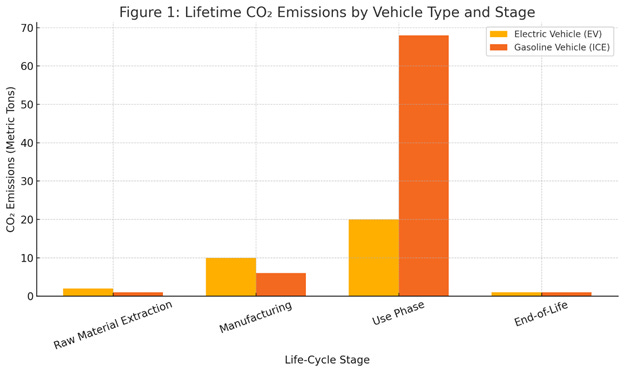
Figure 1: Illustrative lifetime greenhouse gas emissions for an electric vehicle vs. a gasoline vehicle, broken down by life-cycle stage. EVs incur higher manufacturing emissions, but far lower use-phase emissions, yielding about 50% lower total CO₂ over the vehicle’s lifetime.
Beyond Carbon – Water and Air Impacts: If powered by coal-heavy grids, EVs can consume nearly twice as much water as gasoline cars over their life (e.g. 262 m³ vs 137 m³ in one China case study). However, cleaner electricity can dramatically reduce EV water footprints. Air pollutant emissions (NOx, PM, etc.) are virtually eliminated at the tailpipe for EVs, improving urban air quality. In contrast, ICE vehicles emit pollutants that contribute to smog and health problems, a liability increasingly factored into public policy and healthcare costs.
Industry and Investor Risks: Unchecked environmental impacts in the EV supply chain pose material ESG and regulatory risks. There is a “risk that the environmental and social benefits of transitioning to EVs could be offset by the waste, water pollution and high emissions resulting from increased mineral extraction and processing”. Investors may face supply chain disruptions, liability for environmental damage, and reputational harm if companies do not manage these upstream risks. Notably, major automakers have already been linked to deforestation and pollution from Indonesian nickel mining, underscoring the reputational and compliance challenges ahead.
Recommendations: Investors are advised to conduct rigorous due diligence on EV battery supply chains, prioritizing companies that mitigate environmental risks. Strategies include engaging with battery producers and miners on sustainable practices, supporting technologies like recycling and new battery chemistries to reduce virgin mineral demand, and tracking emerging regulations (e.g. the EU Battery Regulation) that enforce carbon footprint disclosure and minimum recycled content in batteries. By focusing on sustainability, investors can better position their portfolios to benefit from the EV boom while avoiding companies with hidden environmental liabilities.