

Company Overview
Regencell Bioscience Holdings Ltd. (RGC) is an early-stage biotech company focused on developing Traditional Chinese Medicine (TCM) therapies for neurocognitive disorders (like ADHD and autism) and infectious diseases (e.g. COVID-19). The company is incorporated in the Cayman Islands with operations in Hong Kong and went public on NASDAQ in July 2021. As a pre-revenue development-stage firm, RGC’s value is largely speculative and hinges on the future clinical and commercial success of its TCM-based treatments.
Insider Trading Activity Analysis
Insider Ownership and Recent Purchases: RGC’s insider ownership is extraordinarily high – CEO and founder Yat-Gai Au controls roughly 86% of the outstanding shares as of March 2025. This concentration increased from about 81% in 2022 due to Au’s consistent share accumulation. Notably, in March 2025, the company (funded by Au’s personal funds) repurchased 652,000 shares from an early investor (Digital Mobile Venture) at an average price of $9.50 – a premium above the then-market price. This $6.2 million buyback effectively removed a large block of shares from the public float and raised Au’s stake to 86%. Au has a history of such insider buying: for example, he made a single US$3.9 million purchase at $29.29/share in 2022, and cumulatively spent over $5.03 million between 2021–2022 on open-market buys. Importantly, no insider sales have been reported in the past year; Au has been the only insider transacting, and only on the buy side.
Patterns, Anomalies, Concerns: The pattern of insider activity at RGC is strongly bullish – the CEO continually buying shares signals confidence in the company’s prospects. In fact, insiders (primarily Au) have bought more shares than they have sold in recent periods, with zero selling. While insider buying is typically a positive sign, RGC’s case is unusual in that one individual’s purchases are essentially propping up the stock and reducing the already tiny float. Au’s ownership (>86%) means only ~14% of shares are in public hands (~1.8 million shares out of ~13 million outstanding), which raises liquidity and governance concerns. Such a small float can lead to extreme volatility (as seen recently) and make the stock susceptible to price manipulation. It also means minority shareholders have little influence – Au’s control ensures he can unilaterally steer corporate decisions. On the positive side, his interests are highly aligned with shareholders (his wealth is tied to RGC’s stock performance), and he has even set symbolic terms like drawing only a $1 salary until the company reaches $1 billion in market cap (a milestone far surpassed in the recent speculative surge).
Overall, insider trading red flags are limited to the lack of diversity in insider holdings and potential illiquidity. There is no sign of insider dumping; rather, the concern is that the stock’s support relies heavily on one insider’s continued confidence and financial ability to buy shares. If Au were to cease backing the stock (or if he ever decided to sell), the impact could be severe given the paucity of other buyers/sellers. Investors should also note that RGC has virtually no institutional ownership (on the order of 0.1% or less) – the shareholder base is almost entirely insiders and retail investors, which can exacerbate volatility and reduce scrutiny on management.
Financial Performance and Forensic Examination of Quarterly Results
Revenue and Earnings Trends: Regencell is pre-revenue – the company reported $0 in revenue in its most recent financial period. This means no product or service income has been realized to date, not unusual for an early-stage biotech, but certainly a red flag in the context of its multi-billion dollar market valuation. The company consistently operates at a net loss. For the six months ended December 31, 2023, RGC had a net loss of approximately $2.19 million (improved from a $3.31 million loss in the comparable half of 2022). On a per-share basis, the half-year loss was about -$0.16. Annualized, one can infer an expected full-year loss in the ~$4–5 million range. These losses are driven entirely by operating expenses since there is no revenue offset.
Expenses and Cash Burn: Operating expenses in the recent half-year were $2.31 million, comprising R&D, general and administrative (G&A), and minor selling costs. Notably, expenses declined ~33% year-on-year for that half-year period – a positive trend, but one that warrants scrutiny. The drop was mainly due to lower R&D spending (only $0.48M versus $1.35M in the prior-year half). Management explained this was partly because of a one-time reversal of share-based compensation (around $0.1M was reversed in the latest period, whereas $0.4M expense was recorded in the prior period), as well as reductions in R&D personnel costs and material purchases. While cutting costs has trimmed the loss, it could be a red flag if it indicates slowed progress in research or pipeline development. G&A expenses also decreased slightly (by 13% to $1.73M) due to lower stock-comp expense and even cutting back on things like corporate apartments for staff.
The company’s cash burn can be approximated by its operating cash outflow. In the last reported fiscal year, operating cash use was around -$4.0 million. As of Dec 31, 2023, RGC had $9.83 million in current assets (primarily cash) against only $0.31 million in total liabilities. This extremely high current ratio (over 40x) underscores that liquidity is strong in the short term and the company carries virtually no debt. Financially, RGC can likely fund its operations for about 2 more years at the current burn rate before needing additional capital. However, without any revenue, the longer-term solvency is a concern – the company will need to either raise funds (equity or debt) or drastically ramp up revenue in the future to continue R&D and eventual commercialization.
Unusual Accounting or Red Flags: From a forensic accounting perspective, RGC’s financial statements are relatively straightforward. With no revenue and mainly cash expenses, there’s little room for aggressive accounting practices like revenue recognition tricks. Some items to note:
The reversal of share-based compensation expense in the recent quarter is an unusual event (likely due to stock options forfeited by a departing employee or a vesting condition not met). This artificially lowered R&D expense in that period by ~$0.3–0.5M. While not improper, it’s a non-recurring adjustment investors should factor out when evaluating the true ongoing expense run-rate.
The balance sheet shows “Other assets” of $0.64M (down from $1.0M in mid-2023). This could include deposits, pre-paid expenses, or possibly capitalized development costs. The decline suggests some of these assets were used or expensed during the half-year. Importantly, there is no indication RGC is capitalizing significant R&D costs as assets (which could mask expenses) – it appears they expense R&D as incurred, which is conservative and appropriate for early-stage research.
There are minor “Other income” items (e.g. $227K in the half-year), likely from bank interest on cash or currency gains, and negligible “Other expense” ($101K). These are small in context and not a major factor in earnings quality.
The presence of a non-controlling interest (loss of $119K attributable to NCI in six months) indicates a portion of the operations is not 100% owned by RGC (perhaps a subsidiary or joint venture). This is relatively small and has minimal impact on shareholders’ net loss. It’s worth monitoring who this NCI is – likely a partner in some project – but given its size, it’s not a significant concern.
Summary of Financial Red Flags: The biggest financial red flag is the complete lack of revenue against a swelling cost base, meaning RGC is entirely dependent on external funding (or insider funding) until it can commercialize a product. The company’s expenses, while currently trimmed, include ongoing cash burn (~$4M/year) and will likely rise if any clinical trials or expansion begins. Another red flag is valuation risk: at recent market prices, RGC’s market capitalization was in the billions (>$6.9B at one point) despite tangible book equity of only ~$10M and accumulated losses. This enormous gap suggests investors are pricing in extreme future success – any delay or failure in development could trigger a sharp correction. On the positive side, liquidity and balance sheet health are good in the near term (lots of cash, negligible debt), and we do not see evidence of earnings manipulation or shady accounting practices. The “quality” of earnings (or rather, losses) is fairly clean – the statements reflect the genuine state of the business (which is early-stage and unprofitable). Overall, financial health is adequate for now but not sustainable long-term without new funding, and earnings quality is acceptable (no obvious red-flag accounting), albeit the lack of any revenue is a fundamental red flag in itself.
Unusual Trading & Volume Activity
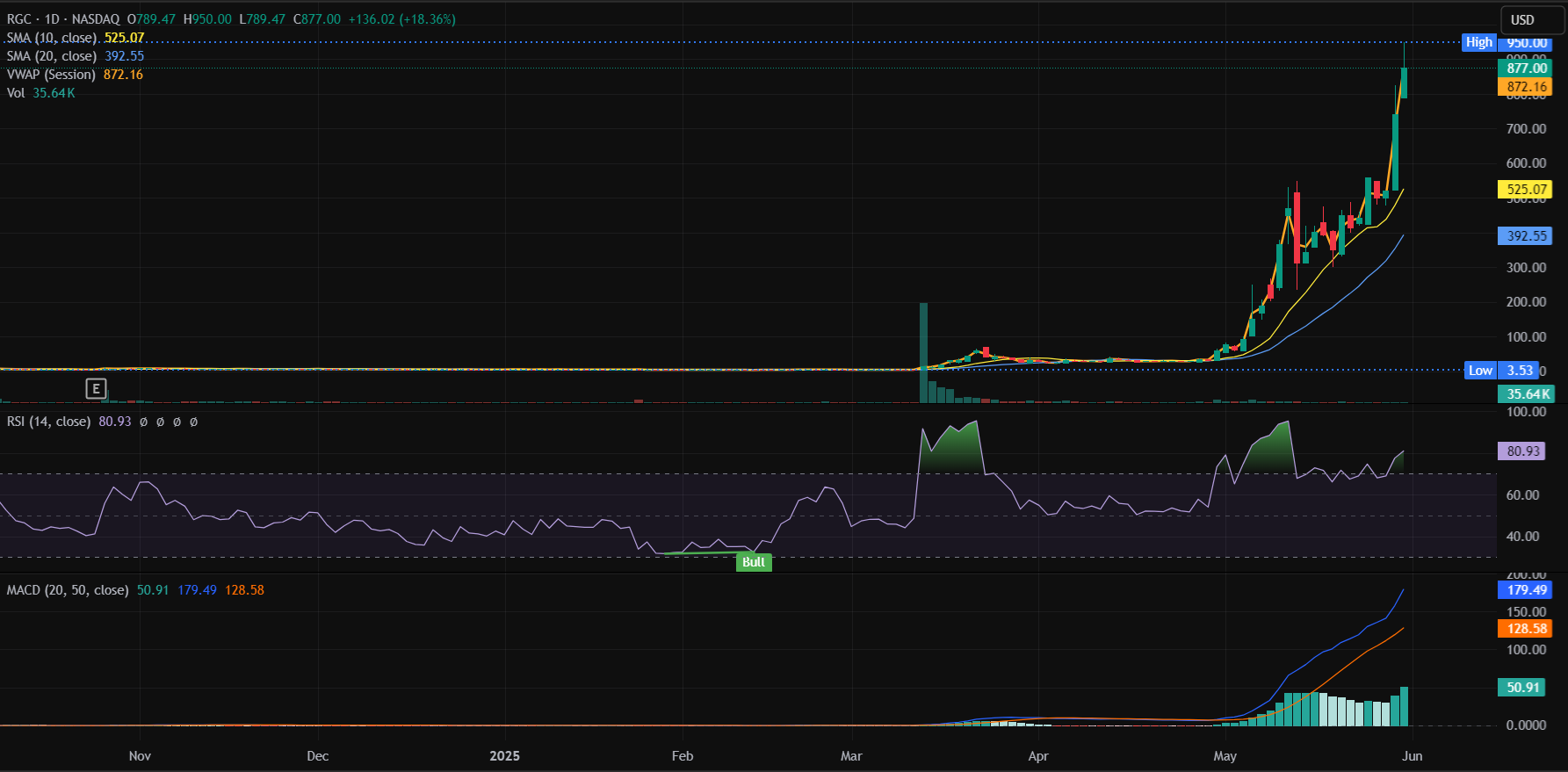
Regencell’s stock has experienced extreme trading anomalies in recent months, entirely disconnected from fundamental performance. Since early 2025, RGC’s share price has skyrocketed in a speculative frenzy: as of late May 2025 the stock was up over 8800% year-to-date. To put this in perspective, RGC started the year around the single-digit dollar range and by May 23, 2025, reached an all-time high of $558.05 intraday. It didn’t stop there – within the next week, shares surged further. On **May 29, 2025, RGC jumped 42.5% **in a single day to close at $740.98, after touching intraday highs in the $830+ range. At one brief peak, the stock traded as high as $950 (intraday) before pulling back, according to trading data. This parabolic ascent propelled RGC’s market cap to about **$6.9 billion at $558/share – an astronomical valuation for a company with no revenue and ~$10M in net assets.
Volume and Liquidity: A striking aspect of these moves is the wild swings in trading volume and liquidity. During some of the biggest price spikes, volume was actually relatively thin – e.g. on May 29, only ~30,926 shares traded (vs. an average of 709,000) while the price jumped over 40%. Such thin volume driving large price moves suggests a classic low-float squeeze: with so few shares available in the public float, even modest buying (or reluctance to sell) can cause outsized price jumps. Earlier in March 2025, when news of the insider-funded buyback broke, volume spiked as momentum traders piled in – the stock surged 235% in one day to $14.09 on March 14, on heavy volume (likely many hundreds of thousands of shares) as that catalyst hit. After that, volume has oscillated, but notably declined even as the stock kept soaring, implying the rally became very order-depleted (few sellers) rather than broad-based buying. This is a red flag that the price action may not be sustainable – low liquidity rallies can reverse violently once sellers emerge.
Trading Halts and Volatility: RGC’s volatility has been so extreme that Nasdaq imposed multiple trading halts in recent weeks. There were numerous volatility trading pauses in April and May 2025 – for example, trading was halted on April 4, April 30, May 5, May 12, etc., and subsequently resumed once order imbalances cleared. These frequent halts are a sure indicator of unstable trading conditions, often seen in microcap “gamma squeeze” or momentum plays. The stock’s technical indicators have been off the charts – by late May, the 50-day moving average was around $161 (vs. price ~$740), and the RSI (Relative Strength Index) hit ~73 (overbought). Such technicals confirm that the stock is extremely overextended in the short term.
Disconnect from Fundamentals: The recent trading activity appears entirely disconnected from RGC’s fundamental value. The stock’s rise has been attributed to a few speculative catalysts:
The March share buyback news (CEO funding the purchase of shares from a large holder) was interpreted as a bullish signal and float reduction, sparking the initial big rally.
There were mentions of “promising clinical trial results” in some media as a catalyst in 2025, although details are scant – any such results have not yet translated into formal product approvals or revenues.
The extremely small float and heavy insider ownership created conditions for a potential short squeeze or momentum squeeze. Interestingly, reported short interest in RGC has actually been very low (only ~1–2% of float shorted as of mid-May), likely because borrowing shares is nearly impossible – the borrow fee spiked to over 700% annualized. Thus, the surge was less a classic short squeeze and more a case of speculative buying and a “fear of missing out” rally among retail traders aware of the low float. In essence, demand completely overwhelmed supply of shares, sending the price into a feedback loop upward.
Forensic red flags abound here. The massive price volatility on relatively low volume is a hallmark of a potentially manipulated or micro-float-driven market. The stock’s valuation metrics are absurd – for example, even after the pullback from highs, RGC traded at well over 1000× book value and an undefined P/E (no earnings). The market sentiment has swung to euphoric levels that are unsustainable long-term. This situation poses serious risk: any negative development – be it a delay in trials, a broader market downturn, or even just profit-taking – could trigger a spectacular collapse in RGC’s share price. In fact, the overbought technical signals and dwindling volume suggested a cresting of the rally as of the end of May. Long-term investors should be extremely cautious; as one analysis noted, the stock’s 42% surge “despite weak fundamentals and significant overvaluation” is a warning sign of purely speculative trading. The recent action is a red flag for market sentiment risk – it’s indicative of a possible bubble in the stock.
Forensic Risk Scores by Category
To summarize RGC’s red flags, we assign forensic risk scores (on a scale of 1 to 10, where 1 = highest risk/poorest and 10 = lowest risk/strongest) across several key categories:
Category
Score
Assessment & Red Flags
Financial Health
5/10
Moderate – The company has no debt and a very high current ratio (41x) indicating ample short-term liquidity. Cash on hand (~$9.8M) can cover operations for ~2 years given current burn rate. However, long-term health is in question with zero revenue and ongoing losses. RGC will require additional financing or a successful product launch in the foreseeable future to remain viable. The balance sheet is tiny relative to the market cap, flagging a risk of overvaluation.
Earnings Quality
7/10
Fair – RGC’s financial statements are straightforward. There’s no revenue to manipulate, and expenses are recorded conservatively (R&D expensed as incurred). We see no major accounting irregularities or aggressive practices. One-off items (e.g. share-based comp reversal) have been transparently disclosed. Thus, reported losses fairly represent economic reality. That said, lack of recurring revenue or profits means traditional quality metrics (earnings stability, accruals, etc.) don’t really apply – the “earnings” are consistently negative. The high score here reflects transparency and simplicity of financial reporting, not the presence of healthy earnings.
Governance Risk
3/10
High Risk – Corporate governance is concerning due to extreme insider control. The CEO/founder owns ~86% of shares and effectively has unchecked voting power. Board independence may be limited; minority shareholders have virtually no say. On one hand, insider ownership aligns management’s interests with shareholders (Au is highly incentivized to build value). On the other hand, it raises risks of key-man dependence and potential conflicts (e.g. related-party decisions or entrenchment). The company’s Cayman incorporation and operations in Hong Kong mean governance and investor protections are those of a foreign private issuer. Positively, insiders have voluntarily extended lock-up agreements (recently locking their shares until April 2026) to signal commitment. Nonetheless, the lack of institutional oversight (only ~0.05% institutional holdings) and heavy insider dominance make governance a red-flag category.
Market Sentiment
2/10
Very Risky – Market sentiment around RGC is in speculative overdrive. The stock’s rapid ascent on thin fundamentals is a sign of hype and potential manipulation. Momentum is sky-high in the short term (YTD +8000%), but this positive sentiment is unstable. Traditional investors (funds, analysts) are virtually absent, indicating that pricing is driven by retail traders and possibly algorithmic momentum strategies. The extremely low float amplifies swings. While sentiment is bullish now, it could turn sharply negative just as fast. The stock is technically overbought and has triggered multiple volatility halts. Additionally, despite rumors of “short squeezes,” actual short interest is minimal (~1–2% of float) – meaning this rally is not grounded in shorts covering but pure demand speculation. Overall, sentiment is a major red flag – it reflects a disconnect from fundamentals and foreshadows high risk of a crash or continued wild volatility.
(Note: Scores above are subjective assessments based on available data and forensic indicators. A lower score = more red flags/higher risk.)
Options Strategy Considerations (3–6 Month Outlook)
Given the highly unusual situation with RGC’s stock, investors may consider options strategies to express bullish or bearish views while managing risk. Importantly, option premiums on RGC are extremely elevated (implied volatility is very high due to the stock’s turbulence), so strategies that involve selling some premium (spreads or covered positions) might be more prudent than straight long options. Below, we outline one bullish and one bearish approach:
View
Potential Options Strategy
Rationale (3–6 month horizon)
Bullish
Bull Call Spread (e.g. buy an at-the-money call, sell a farther out-of-the-money call). Alternate: Bull Put Credit Spread (sell a moderately out-of-the-money put, buy a lower-strike put for protection).
Upside Exposure with Limited Risk: A call spread lets a bull participate in further upside without paying the full cost of a naked call in this high-volatility environment. For example, one might buy a call at around the current price level and sell another call at a much higher strike (to offset cost); this caps maximum gain but significantly reduces premium paid. Given RGC’s recent range, strikes might be wide apart (reflecting hundreds of dollars difference) to allow upside room. The alternate bull put spread generates income if the stock stays elevated: for instance, selling a put at a strike well below the current price (betting that the stock will remain above that level in 3–6 months) and buying a deeper out-of-the-money put as insurance. Because RGC’s option premiums are rich, the credit received can be substantial. This strategy profits if RGC’s price doesn’t fall below the short put strike by expiry. It’s a way to go long implicitly (by being short puts) with defined risk (limited by the long put). Both strategies acknowledge that outright calls are extremely expensive; by spreading or using puts, the bull takes advantage of high implied volatility to reduce net cost. The risk is limited in both cases: the call spread’s max loss is the paid premium, and the put spread’s max loss is the difference in strikes minus net premium (if the stock plunges through both strikes). These are prudent given the unpredictable swings.
Bearish
Long Put or Put Spread (e.g. buy a put near current price; optionally sell a much lower strike put to offset cost). Alternate: Bear Call Spread (sell an out-of-the-money call, buy a higher-strike call as hedge).
Downside Protection or Speculation: A straightforward way to bet on a decline (or hedge long stock) is buying puts. A 3–6 month put option with a strike near current levels gives the right to sell RGC at that strike – if the stock collapses from its speculative heights, the put could pay off dramatically. However, puts are costly due to high volatility. To make this more cost-effective, one could use a put debit spread: for example, buy a put at a strike somewhat above the current price and sell another put at a much lower strike (where one might reasonably see the stock bottoming). This limits the maximum gain (if the stock really cratered below the lower strike), but drastically lowers the upfront premium. It’s a bet that RGC could fall into that range. Another bearish approach is a bear call spread – selling an out-of-the-money call (above current price) and buying an even higher call for protection. This generates an immediate premium and will profit as long as RGC does not continue an extreme rise beyond the short call’s strike. Essentially, one is taking the position that the stock’s upside is capped or due for a reversal. The bought call limits risk if the mania runs even further. Both bearish strategies aim to capitalize on the likelihood of a pullback after a parabolic rise. The put-based strategy directly gains from a drop; the call spread yields income if the stock stalls or falls. Given RGC’s weak fundamentals and overvaluation, a bearish stance has logical merit – but timing is critical. Options allow the bear to define risk (important, since an irrational rally can last longer than expected). Investors must be prepared for continued volatility; hence, defining risk via spreads is wise.
Strategy Note: Traders should size positions conservatively. The options market on RGC may be illiquid with wide spreads, so limit orders and caution are advised. Also, due to the potential for rapid price moves or trading halts, both bulls and bears might consider longer-dated options (3–6 months or more) to give time for their thesis to play out and to weather interim volatility. The high option premiums mean that breakeven levels will be far from the current price – one must have a strong conviction on significant movement (or stability, in the case of selling premium) to profit. In sum, using options can help manage risk in this extremely speculative stock, but they do not remove risk entirely; there is still potential for large losses if RGC’s price moves against the position suddenly.
Conclusion
Regencell Bioscience presents a high-risk profile on multiple fronts. Insider activity shows a committed founder who continues to buy and hold an overwhelming stake, which supports the stock but also results in a perilously small float and concentrated control. The financial forensics reveal no revenues and ongoing losses, meaning the current multi-billion valuation is built on hope and hype rather than fundamentals. Recent quarterly results actually showed cost-cutting and a smaller loss, but this came via reduced R&D spending and one-off adjustments – a double-edged sword if it slows progress. The market’s behavior around RGC’s stock is perhaps the greatest red flag: massive price dislocations, trading halts, low liquidity, and technical overbought signals all point to a stock price divorced from intrinsic value. Market sentiment can be characterized as speculative mania, which could reverse with little warning.
For investors, the key takeaways are cautionary. Governance and liquidity risks mean any investment in RGC is at the mercy of a single individual’s strategy and a volatile microcap market. While the upside of catching a momentum wave is obvious (the stock’s recent history is testament to that), the downside risk is profound – a collapse in price could be as swift as the ascent. Deploying options strategies as discussed – either to speculate on further upside with limited risk, or to bet on/hedge for a decline – might be more prudent than buying or shorting the stock outright, given the circumstances. Ultimately, a SignalVest-style forensic review flashes multiple red flags on RGC: Financial Health is tenuous long-term, Earnings Quality is acceptable but based on nothing, Governance is risky due to insider dominance, and Market Sentiment has entered irrational territory. Investors should conduct thorough due diligence and be prepared for continued volatility if engaging with this stock in any capacity.