Revenue Recognition Practices
Meta recognizes revenue primarily from advertising contracts, billed when impressions or engagements occur, and from reality hardware and services as they are fulfilled. Key areas noted:
Advertising credits, incentives, and pricing fluctuations can introduce timing discretion
Reality Labs (Metaverse) sales are bundled with services and warranties, invoking multi-element arrangements and performance obligation judgments
Risk Note: While Meta complies with ASC 606, the layered judgment in revenue allocations and bundled recognition across AI, ads, and hardware opens potential for earnings smoothing — especially as Meta transitions between growth narratives.
Expense Capitalization & Long-Term Investment Visibility
Meta capitalizes significant infrastructure costs (data centers, AI accelerators, custom chips) tied to its long-term AI buildout.
Capital expenditures reached $32 billion in 2024 — the highest in company history.
These costs are depreciated across long lives, but revenue contribution from AI investments is still nascent.
Red Flag: There is a clear risk of under-realized ROI on CAPEX. Large capitalized bets into speculative segments (e.g., Reality Labs, open-source AI) can overstate current operating margins by deferring real risk into future periods.

Insider Control and Concentration
Mark Zuckerberg retains approx. 54% of voting control via dual-class shares.
Insider sales were lower in 2024 than prior years, but stock-based comp remains aggressive across R&D and G&A.
Board diversity and independence have improved, but governance remains asymmetric.
Interpretation: Control structures may suppress institutional pushback. Compensation alignment has improved post-2022 restructuring, but fundamental power asymmetry remains unaddressed.
Auditor's Report
Ernst & Young issued an unqualified opinion on both the financial statements and internal controls.
No Critical Audit Matters (CAMs) directly flagged, but disclosures note high estimation risk in:
Revenue recognition allocations
Deferred tax asset realization
Stock-based compensation
Watchpoint: Meta’s scale and disclosure quality pass clean audits — but investor over-reliance on reported segments without internal margin data (e.g., AI, Metaverse) increases narrative risk.
No Explicit Red Flags for Related Party Transactions or Off-Balance Items
No material disclosures of related-party transactions.
No visible off-balance sheet liabilities, variable interest entities (VIEs), or special-purpose vehicles.
Meta’s structural transparency remains industry-grade.

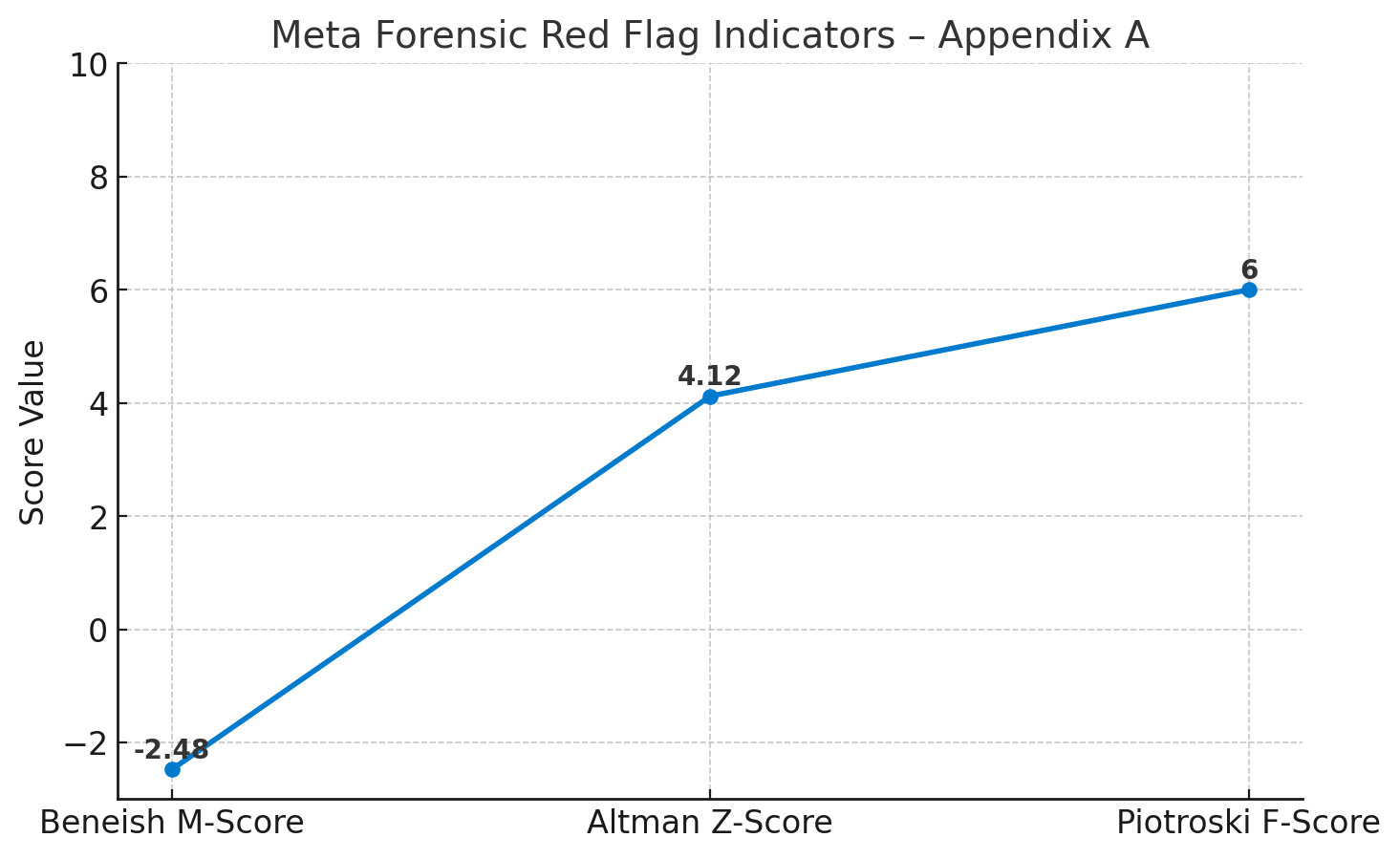
Appendix A — Forensic Red Flag Indicators