Executive Summary
Super Micro Computer, Inc. (SMCI) faces elevated forensic risk and governance red flags following a period of explosive growth and recent accounting scrutiny. Financial forensic indicators show multiple warning signs: SMCI’s Beneish M-Score suggests potential earnings manipulation (M ≈ +0.50, well above the -1.78 risk threshold), driven by surging receivables, inventory, and accruals. Its Sloan accrual ratio (~54%) indicates over half of FY2024 earnings were non-cash, flagging poor earnings quality. A Piotroski F-Score of 2/9 (low) reflects deteriorating fundamentals (e.g. margins down, cash flow negative). While bankruptcy risk appears low (Altman Z ~9.7, safely above 3.0; Ohlson O-Score well below distress levels), the financial profile is aggressive, with $3.9B raised in FY2024 via equity and zero-coupon convertible debt to fuel growth.
Governance and controls present severe red flags. In October 2024, SMCI’s auditor Ernst & Young resigned, citing an inability to rely on management’s representations and unwillingness to be associated with SMCI’s financials. This followed short-seller allegations (Aug 2024 by Hindenburg Research) of accounting manipulation and a 10-K filing delay. A Special Committee investigation reported “no evidence of misconduct” but recommended a CFO change, and the CFO is being replaced. The new auditor BDO gave an adverse opinion on internal controls, identifying multiple material weaknesses (IT controls, segregation of duties, journal entry approvals, inadequate documentation, and undisclosed related party/lease transactions). SMCI in FY2024 disclosed its internal controls over financial reporting were not effective. Meanwhile, U.S. regulators are probing the company: SMCI received DOJ and SEC subpoenas in late 2024 seeking documents related to the short-seller claims. Multiple shareholder lawsuits were filed alleging fraud.
SMCI’s capital structure and dilution risk are moderate but notable. The company raised $2.3 billion in new equity in 2024 (diluting shares ~11% YoY) and issued $1.7 billion of 0% convertible notes due 2029, followed by $700 million of 2.25% converts due 2028. These moves fortify liquidity (cash $1.67 B) but introduce potential future dilution if converted (conversion terms not disclosed) and significant debt obligations. Total debt jumped to ~$1.9 B by Jan 2025. Concentration risks also bear mention: SMCI relies on a few key suppliers and customers. Two related-party suppliers (Ablecom & Compuware, run by the CEO’s brothers) account for ~4.3% of cost of sales, and nearly 100% of those firms’ sales are to SMCI – raising conflict-of-interest and continuity concerns. Moreover, Nvidia is a critical GPU supplier, and amid SMCI’s turmoil Nvidia’s CEO openly endorsed a competitor (Dell) in May 2024, with reports that major customers like CoreWeave and Tesla have shifted orders from SMCI to Dell. The customer base is diversifying, but losing “hyperscaler” clients (e.g. Amazon AWS, which cut ties after delivery issues) adds concentration risk.
Composite Red Flag Score – 77/100 (High Risk): We assign SMCI an overall “Red Flag” score of 77 (on 100-point scale), reflecting high forensic risk and governance concerns partially offset by a solid solvency profile. The score components are detailed below, weighted by SignalVest methodology (40% forensic, 30% governance, 20% capital/dilution, 10% concentration):
Forensic Financial Risk: 9/10 (High) – Multiple indicators of potential earnings management and aggressive accounting (high M-Score, accruals, etc.).
Governance & Controls: 9/10 (Severe) – Auditor resignation, internal control failures, related-party dealings, regulatory investigations.
Dilution & Capital Structure: 5/10 (Moderate) – Large equity/debt raises have bolstered cash but increased leverage and future dilution overhang.
Concentration Risk: 6/10 (Moderate/High) – Reliance on CEO-affiliated suppliers; key component (GPU) supply from Nvidia in question; some large customers defecting.
Overall, SMCI’s red flag profile is elevated. Investors should exercise caution: the company’s meteoric revenue growth (110% in FY2024) has come with significant governance baggage and financial reporting risk. Continued success in the AI server market will depend on remediating control weaknesses, restoring auditor/regulator confidence, and managing supply-chain and customer relationships amid intense scrutiny.
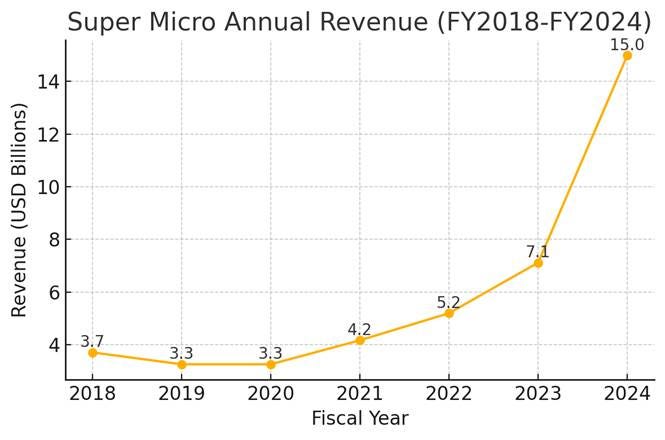
Fig.1: SMCI’s annual revenue exploded from ~$3.3 B in FY2019–FY2020 to $15 B in FY2024 (fiscal year ended June). This growth was driven by surging demand for AI servers, but it also coincided with aggressive accounting practices flagged by forensic models.
SignalVest Red Flag Intelligence Score
Using SignalVest’s composite scoring, we rate SMCI’s risk areas as follows:
Forensic Financial Risk – HIGH (40% weight): Multiple forensic accounting scores flash red. The Beneish M-Score is approximately +0.50, far above the typical fraud risk threshold of -1.78, due to days sales in receivables rising (AR up 2.4× on 2× sales) and gross margin deterioration (GM fell to 13.7% in FY2024 from 18.0% in FY2023) – patterns consistent with possible revenue recognition tricks or cost deferral. SMCI’s inventory ballooned to $4.33 B (+200%) in 2024, contributing to negative operating cash flow. The Sloan Accrual Ratio (net income minus operating cash flow, divided by average assets) is ~0.54, indicating over half of earnings were accrual-based – a very large divergence (healthy firms are typically <0.10). The company’s Piotroski F-Score is 2/9, signaling poor quality of earnings and weakening fundamentals (e.g. FY2024 saw lower ROA, a drop in gross margin, negative cash flow, and equity issuance – all F-Score negatives). On the positive side, Altman Z-Score ~9.7 for FY2024 indicates a very low bankruptcy risk given high working capital and a huge market cap buffer. Similarly, the Ohlson O-Score model suggests a low probability of near-term default (SMCI’s profitability and liquidity keep its O-Score well below the high-risk cutoff of 0.5). Overall, the **forensic metrics depict a company with robust solvency but possible earnings manipulation and aggressive accounting – a classic red flag profile for a high-growth “story stock.” We assign 9/10 on forensic risk. Key inputs are detailed in the Appendix.